
A mobile number is part of everyday life. We use it for personal conversations, professional communication, banking, online accounts, business enquiries and social connections. In numerology, numbers are traditionally believed to carry symbolic qualities, which is why some people prefer to examine the numerical pattern of a phone number before choosing or changing it. A lucky mobile number is generally identified by adding the individual digits of the phone number and interpreting the final single-digit total.
The process does not mean that one number can guarantee success, money, happiness or favourable events. Numerology is a belief-based system rather than a scientifically proven method. Its value is mainly in personal interpretation and reflection. When people search for a lucky mobile number, they commonly consider the mobile-number total, birth number, life path number and the purpose for which the phone number will be used.
Someone selecting a number for business communication may have different priorities from someone choosing one mainly for family and personal use. The better approach is therefore to understand how mobile number numerology works and then evaluate whether the result matches your personal goals.
This prevents you from selecting a number simply because it contains repeated digits such as 7, 8 or 9. Attractive number patterns can be memorable, but numerology generally looks beyond appearance and examines the numerical value created by the entire sequence.
What Is a Lucky Mobile Number in Numerology?
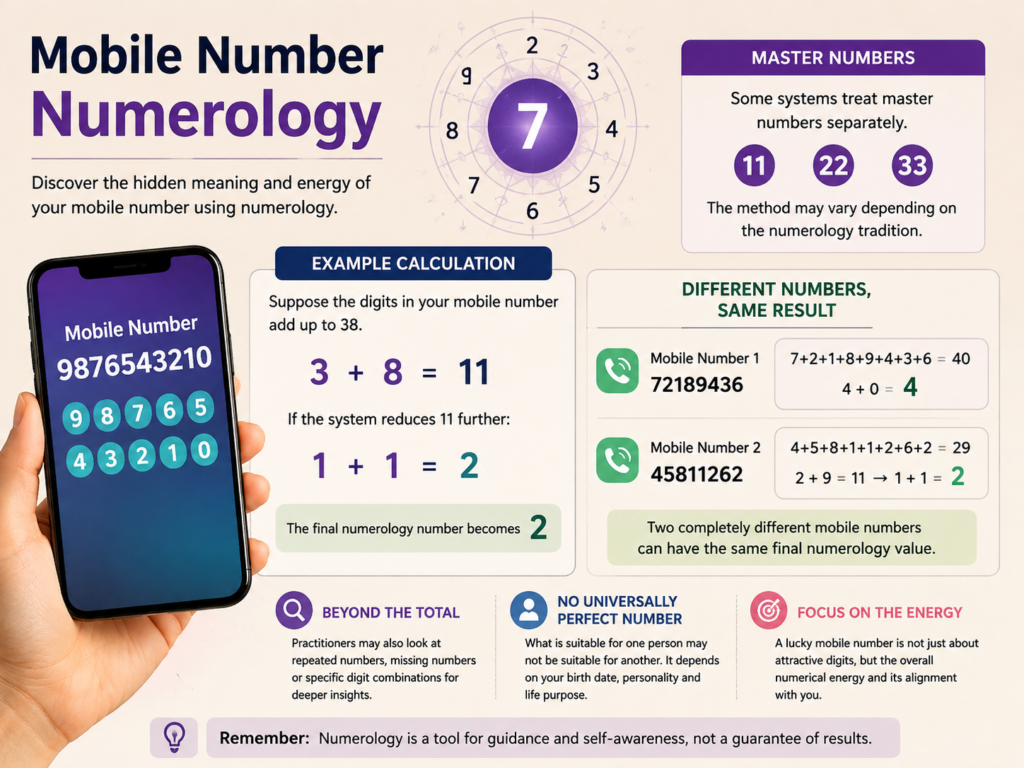
Mobile number numerology studies the combined numerical value of the digits in a phone number. Instead of judging a number only by how attractive or easy to remember it appears, numerologists normally add the digits together and reduce the resulting total to a single digit between 1 and 9.
Some numerology systems may treat master numbers such as 11, 22 or 33 separately rather than immediately reducing them further. The exact method can therefore vary depending on the numerology tradition being followed.
For example, suppose the digits in your mobile number add up to 38.
The calculation would be:
3 + 8 = 11
If the system reduces 11 further:
1 + 1 = 2
The final numerology number becomes 2.
A lucky mobile number is therefore not simply a number that contains supposedly fortunate digits. Two completely different phone numbers can produce exactly the same final numerological value even when their individual digits appear very different.
Some practitioners also examine repeated numbers, missing numbers or particular digit combinations. These additional observations may provide further interpretation, although the main reduced total remains one of the most commonly used starting points.
This also explains why there is no universally perfect mobile number. What appears suitable for one person may not be considered equally suitable for someone with a different date of birth, personality or objective.
How to Calculate Your Mobile Number
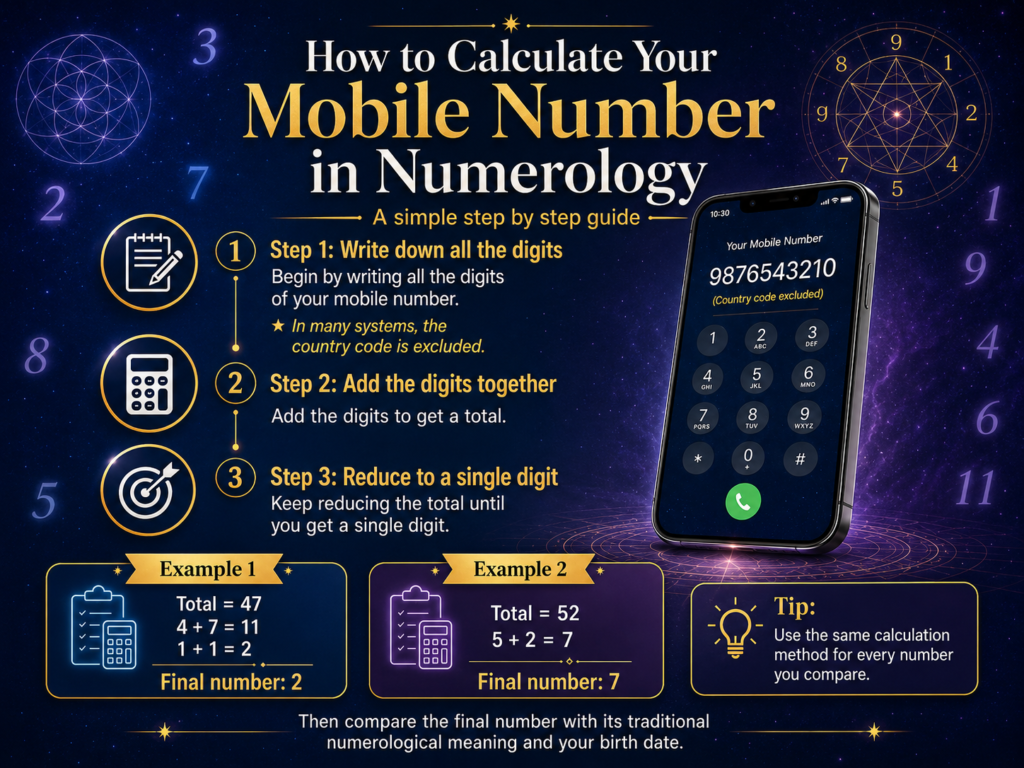
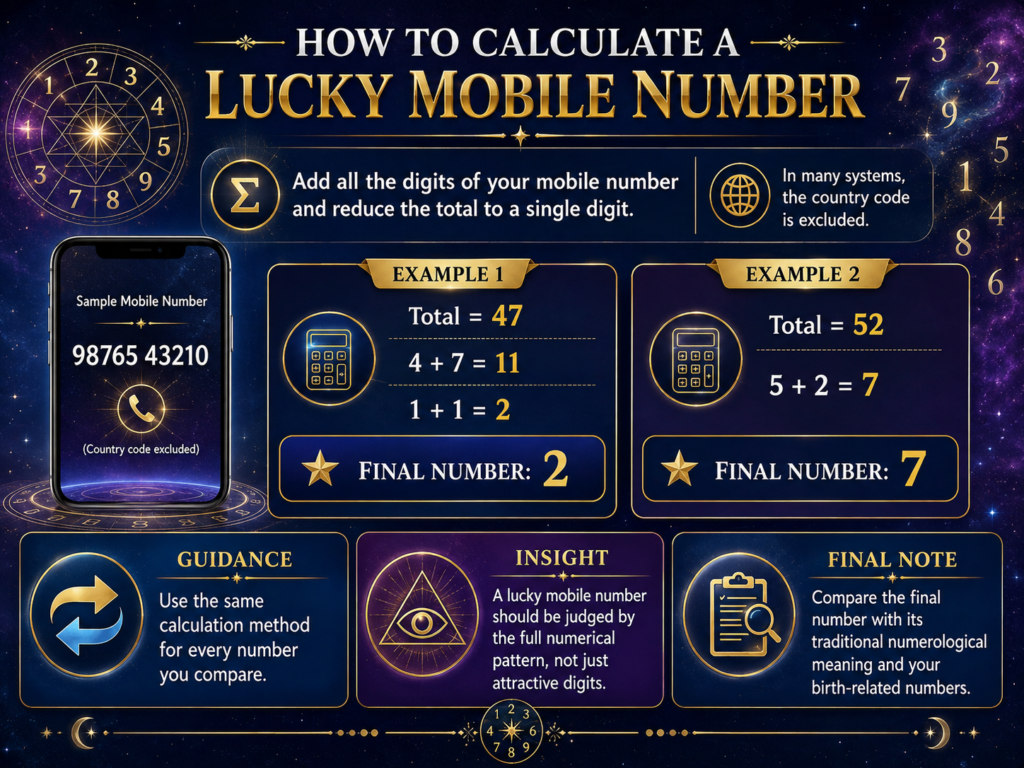
Calculating the numerological value of a mobile number is relatively straightforward. Begin by writing down all the digits of the phone number and adding them together.
In many commonly used systems, the country code is excluded from the basic calculation. However, different numerology practitioners may use slightly different methods, so it is important to remain consistent once you choose a calculation system.
For example, suppose all the digits of a mobile number total 47.
Calculate:
4 + 7 = 11
If you are reducing the result further:
1 + 1 = 2
The final number is 2.
Now imagine another phone number where the digits total 52.
5 + 2 = 7
The final numerological value is 7.
When comparing several available phone numbers, calculate all of them using exactly the same process. Changing the method for different numbers can produce inconsistent results and make comparison difficult.
A lucky mobile number should ideally be evaluated as a complete numerical pattern rather than by focusing only on one attractive digit. Repeated digits can certainly make a phone number memorable, but they should not automatically determine your choice.
Once you calculate the final digit, study its traditional numerological qualities. You can then compare those qualities with what you want the number to represent in your personal, professional or business life.
Keeping your date of birth available can also help with the next stage because many numerology methods compare the mobile-number value with birth-related numbers.
What Do Numbers 1 to 9 Mean in Mobile Numerology?
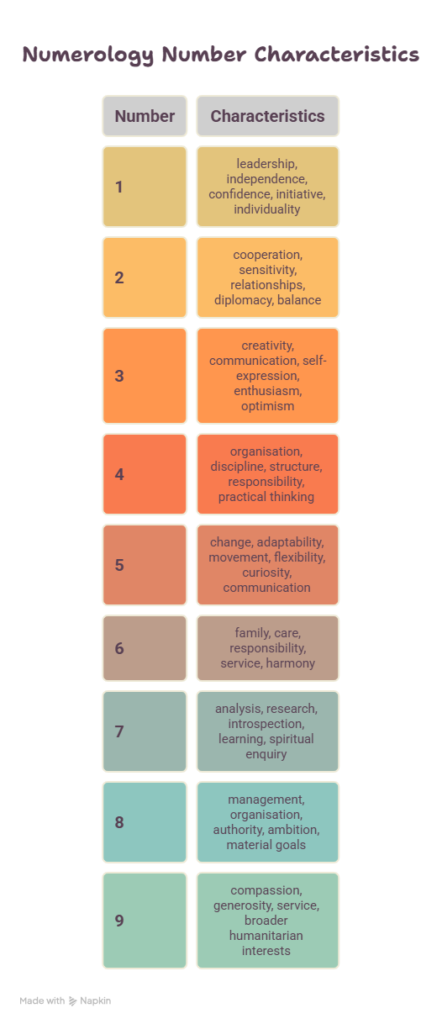
Each number from 1 to 9 is traditionally associated with certain characteristics in numerology. Understanding these meanings can make it easier to interpret the final result of your mobile number calculation.
Number 1 is commonly associated with leadership, independence, confidence, initiative and individuality. People drawn to leadership-oriented qualities may find this number interesting.
Number 2 is traditionally connected with cooperation, sensitivity, relationships, diplomacy and balance. It is often interpreted as a softer and more partnership-oriented number.
Number 3 is associated with creativity, communication, self-expression, enthusiasm and optimism. It may appeal to people involved in communication or creative fields.
Number 4 represents organisation, discipline, structure, responsibility and practical thinking. It is generally linked with methodical and stable qualities.
Number 5 is connected with change, adaptability, movement, flexibility, curiosity and communication. It is often associated with people who prefer variety and dynamic environments.
Number 6 is traditionally related to family, care, responsibility, service and harmony. It may represent a more nurturing and supportive numerical influence.
Number 7 is linked with analysis, research, introspection, learning and spiritual enquiry. It is frequently associated with deeper thinking and knowledge.
Number 8 is traditionally connected with management, organisation, authority, ambition and material goals.
Number 9 is associated with compassion, generosity, service and broader humanitarian interests.
When identifying a lucky mobile number, do not assume that one of these digits is automatically good while another is bad. The more useful question is whether the traditional qualities of the final number match the characteristics you want to emphasise.
The interpretation should remain personal rather than being based purely on popular beliefs surrounding individual digits.
How to Match a Mobile Number With Your Date of Birth
A person’s date of birth plays an important role in many numerology systems. Two of the most commonly discussed personal numbers are the birth number and life path number.
The birth number is generally calculated from the day of the month on which you were born.
For example, if someone was born on the 23rd:
2 + 3 = 5
The birth number becomes 5.
The life path number normally uses the complete date of birth. Each part of the birth date is added and reduced according to the numerological method being followed.
Once your personal numbers are calculated, they may be compared with the total value of your mobile number.
Some numerology traditions consider particular numbers compatible with each other, while other systems use planetary associations or different compatibility principles. Because these methods can vary, it is better to use one consistent system instead of combining several unrelated rules.
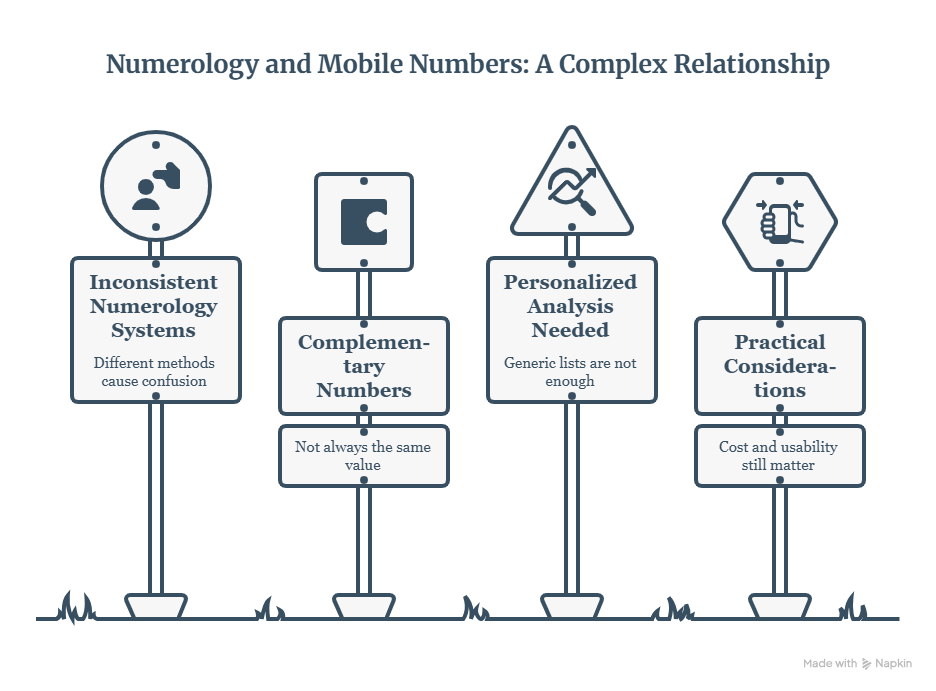
A lucky mobile number does not necessarily need to have exactly the same value as your birth number. Some numerology approaches consider complementary numbers equally meaningful.
This is where personalised analysis can provide more context than a generic list claiming that one specific digit is fortunate for everyone.
Your date of birth may help narrow down several suitable mobile-number options, but practical considerations still matter. Cost, network availability, ease of remembering the number and long-term usability should all be considered before changing an existing phone number.
How to Choose a Number for Career, Business and Personal Goals
The purpose for which you use your phone number can influence the qualities you want to examine.
A business owner may use one mobile number for customers, suppliers, marketing enquiries and professional networking. Someone using a phone mainly for personal conversations may naturally have different priorities.
Before choosing a lucky mobile number, write down what you want the number to symbolically represent.
Your goal could include:
- Stronger communication
- Professional confidence
- Business growth
- Stability
- Creativity
- Networking
- Leadership
- Better focus
- Personal balance
Once the objective is clear, compare it with the traditional characteristics of your calculated numerology number.
For example, someone who values communication and adaptability may be interested in numerical qualities traditionally linked with expression and movement. Someone focused on organisation or management may prefer characteristics associated with discipline, structure or authority.
However, changing a phone number should never be viewed as a replacement for practical action. Business growth still depends on planning, customer relationships, product quality, marketing, financial decisions and consistent effort.
Similarly, professional growth depends on knowledge, skill development, communication and decision-making.
Numerology can therefore be used as an additional personal framework rather than as a promise of a particular outcome.
For a professional or business phone number, memorability is also important. An easy-to-remember number can have genuine practical value when customers need to contact you repeatedly.
The ideal choice combines practicality with the numerical interpretation that feels suitable to you.
Final Checks Before You Change Your Mobile Number
Before making a final decision, calculate your shortlisted numbers again. A small addition error can completely change the final numerology value.
Then compare each option according to:
- Final numerical value
- Traditional number meaning
- Birth number compatibility
- Life path considerations
- Personal or business purpose
- Memorability
- Availability
- Cost
- Long-term convenience
A lucky mobile number should feel personally meaningful while also functioning effectively in everyday life.
Be cautious about claims suggesting that a particular phone number can guarantee wealth, marriage, promotions, business success or protection from difficulties. Numerology cannot scientifically guarantee these outcomes.
If you are comparing several numbers and want a more detailed interpretation, a personalised consultation may examine your date of birth, name-related numbers and other numerological factors rather than looking only at your phone number.
Can any mobile number become numerologically suitable?
Different phone numbers produce different totals. Their suitability depends on the interpretation method being used and how the result is compared with the individual’s personal numbers.
Should the country code be included?
Many basic mobile numerology calculations use only the main phone-number digits. Some systems use different rules, so consistency is important.
Is 8 always considered the best number for business?
No. Although 8 is traditionally associated with management, ambition and material matters in some systems, that does not automatically make it suitable for every person.
Should the phone-number total match the birth number?
Not necessarily. Some numerology methods also recognise compatible or complementary numbers rather than requiring an exact match.
Do repeating digits automatically make a number lucky?
No. Repeated digits may be interpreted within certain numerology systems, but the entire number and its final total should still be considered.
Ultimately, selecting a lucky mobile number is about balancing numerological interpretation with common sense. Choose a number that is practical, affordable and suitable for your communication needs while using numerology as an additional tool for personal reflection.
If you want to explore your personal numbers more deeply, you can also use the resources available through SV GNAN and examine how your birth details and numerical patterns may be interpreted together.